The firm was winning work. The problem was making a signed engagement operationally ready without replaying the sales conversation — and without the founder as the bridge every time.
Northline Talent Partners is a fourteen-person specialized recruiting firm serving skilled-trades, operations, and frontline-leadership clients, with a CRM, an ATS, and a capable delivery team. What it lacked was one dependable path carrying client context from the first commercial conversation into delivery. The engagement focused on making that handoff transferable and measurable — standardizing ownership, stage exits, next actions, readiness gates, exception rules, and the visibility needed to run the business without reconstructing status by hand.
Company names, identifying details, and selected operating data have been altered, composited, or modeled for privacy and demonstration purposes. The before/after figures below are drawn from a consistent 12-month baseline and 12-month post-redesign operating dataset. They are not a guarantee of future results.
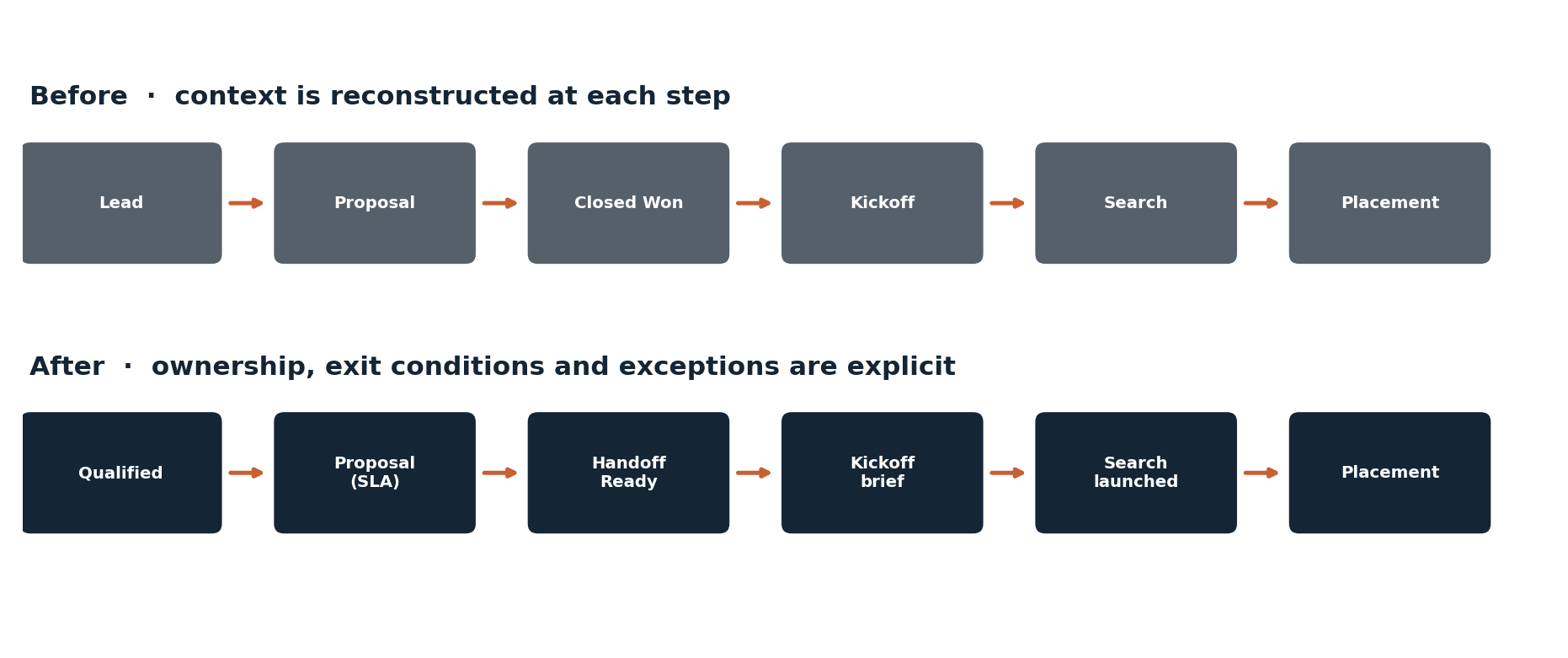
Closed Won is not Handoff Ready.
Opportunities moved through the CRM, but follow-up depended on individual habits, and signed work entered delivery before context was complete. Recruiters rebuilt what sales already knew, searches stalled for missing information, and the founder stayed the bridge whenever the systems disagreed. Pipeline visibility and delivery visibility were never actually connected.
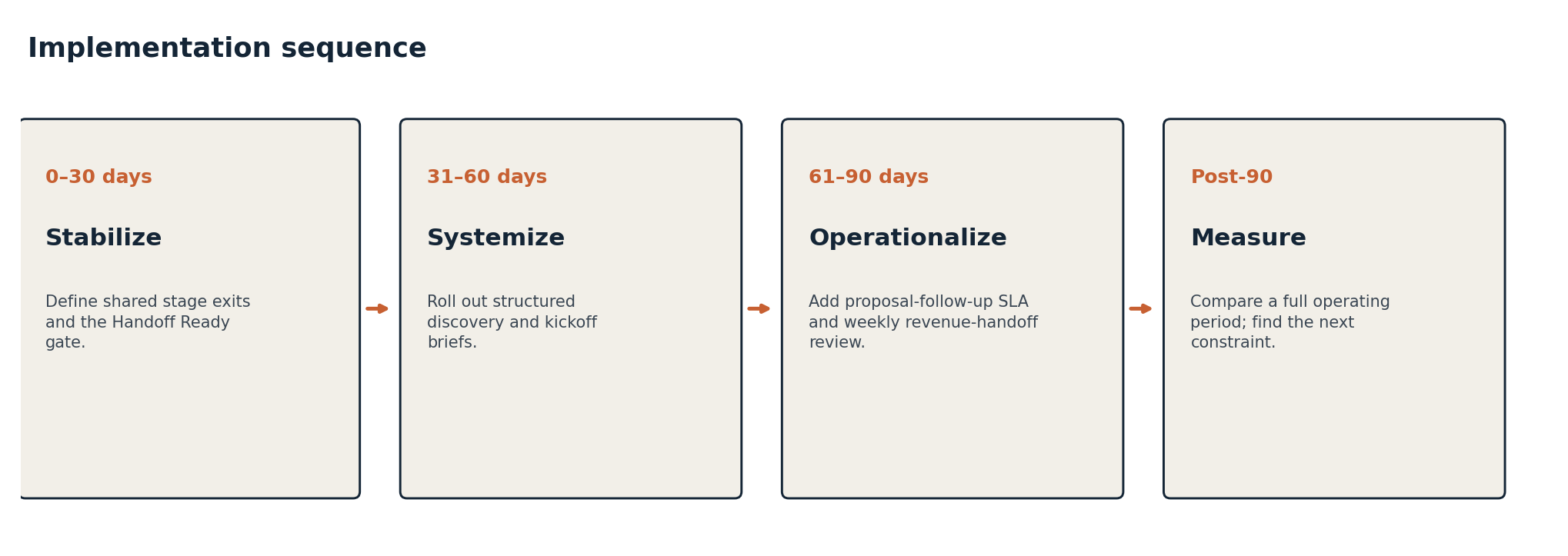
Clear, written conditions for what must be true to leave each CRM stage, so stages mean the same thing to everyone.
A signed engagement reaches delivery only when the required context is captured, not just when it is Closed Won.
A consistent brief so delivery inherits the client context instead of re-interviewing the account.
A defined follow-up rhythm so proposals are advanced on time rather than by whoever remembers.
A short standing review connecting pipeline and delivery, surfacing only what is off track.
One view linking commercial and delivery status, so the founder carries judgment, not missing context.
The founder carries judgment — not missing context.
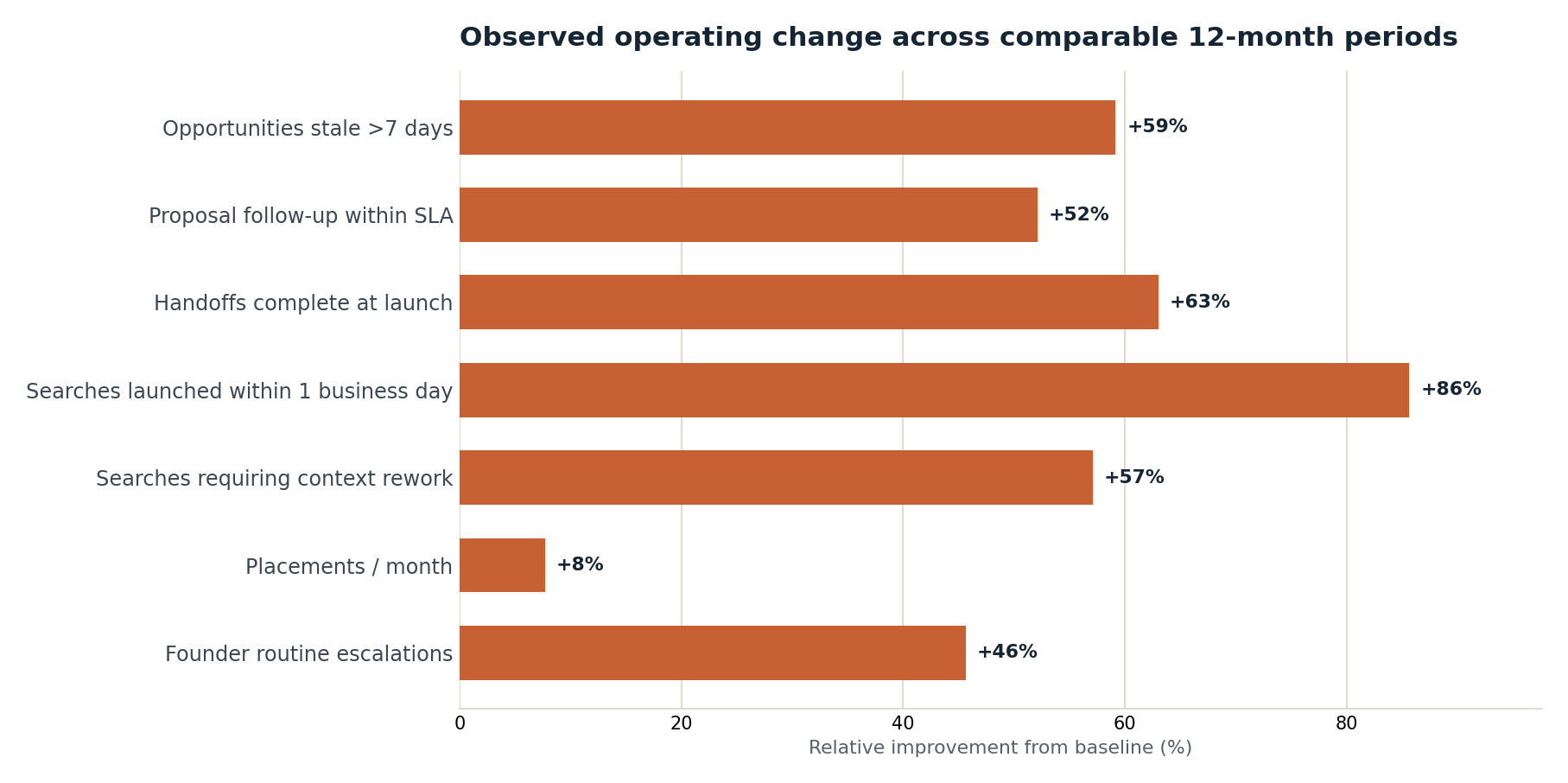
Across the 12-month post-redesign period, the redesigned operating system moved the handoff metrics most tied to delivery speed and founder dependency. Placements improved modestly; handoff quality and follow-up discipline improved more, which is exactly where the constraint was.
| Measure | Baseline | Post-redesign |
|---|---|---|
| Opportunities stale >7 days | 9.3 | 3.8 |
| Proposal follow-up within SLA | 59.3% | 90.2% |
| Handoffs complete at launch | 50.0% | 81.5% |
| Searches launched within 1 business day | 43.1% | 80.0% |
| Searches requiring context rework | 43.1% | 18.5% |
| Placements / month | 7.8/mo | 8.4/mo |
| Founder routine escalations | 11.4/wk | 6.2/wk |
Figures reflect a modeled before/after operating dataset for privacy and demonstration. They describe results within this case, not guaranteed outcomes or industry benchmarks.
Book a free Workflow Assessment and map how signed work becomes delivery-ready — before adding another tool, person, or layer of management.
Book a Free Workflow Assessment →