See the portfolio by exception, not by interruption. Leadership had plenty of data; what it lacked was a reliable way to see which parts of the portfolio actually needed intervention.
Harborline Residential is a regional residential property manager overseeing roughly 780 long-term rental units across multiple communities and scattered-site homes. Maintenance, unit turns, leasing, collections, vendor work, and owner reporting each moved, but nothing gave a shared, trustworthy portfolio view. The engagement focused on making the workflow transferable and measurable before adding more technology — standardizing ownership, stage exits, next actions, readiness gates, exception rules, and the visibility needed to run the business without reconstructing status by hand.
Company names, identifying details, and selected operating data have been altered, composited, or modeled for privacy and demonstration purposes. The before/after figures below are drawn from a consistent 12-month baseline and 12-month post-redesign operating dataset. They are not a guarantee of future results.
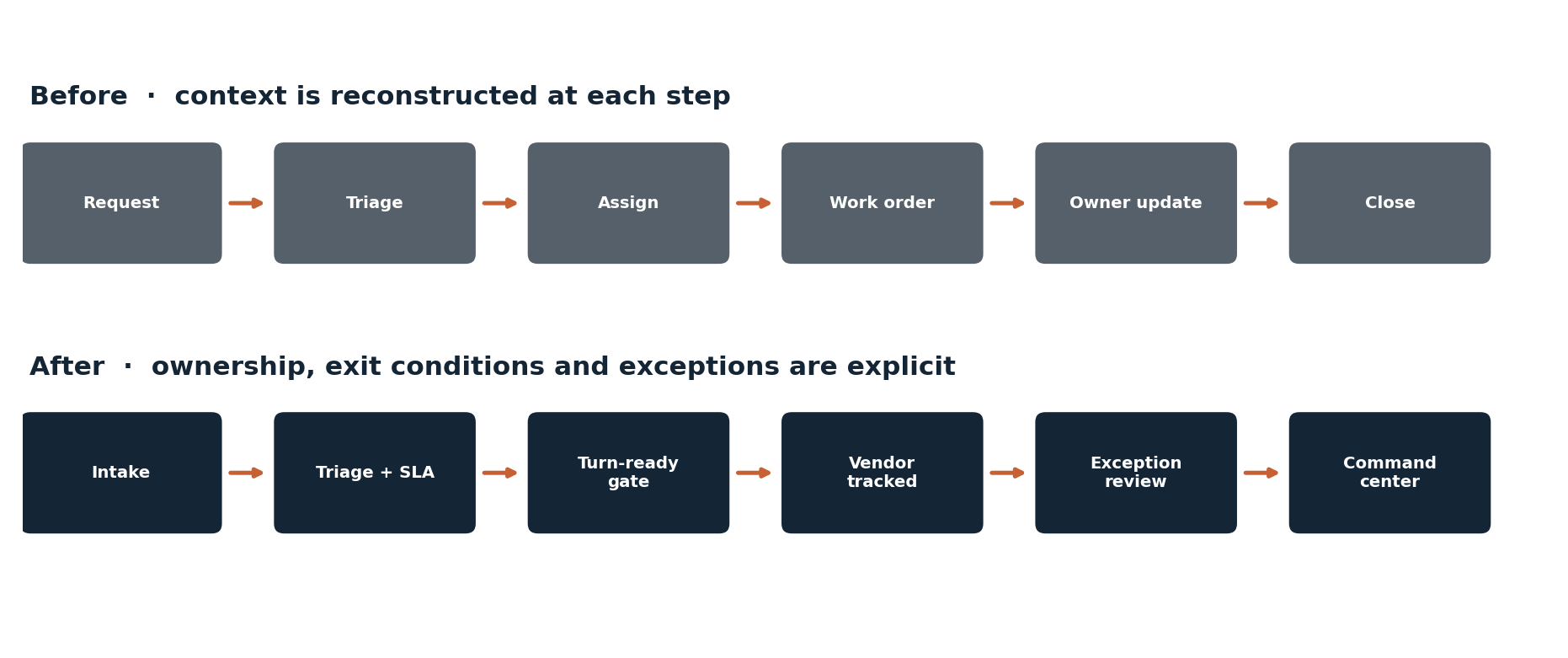
More units created more noise — not more visibility.
Growth added units, residents, vendors, and transactions without a consistent portfolio-control layer. Leadership spent too much time reconstructing status and chasing missing context — reacting to whatever surfaced instead of seeing the portfolio by exception. A unit turn, in particular, was treated as a maintenance task when it is really a cross-functional workflow.
Shared triage and SLA rules so every work order is prioritized the same way, not by whoever picks it up.
A turn counts as ready only when the required steps are complete, so vacancy days stop hiding in the schedule.
Defined action paths so aging balances and owner updates follow a repeatable process, not memory.
A vendor scorecard that makes cost, speed, and rework visible instead of anecdotal.
A short standing rhythm that surfaces only what is off track and needs a decision.
One exception-first view of the whole portfolio, so leadership sees what needs attention at a glance.
A decision queue — not another dashboard.
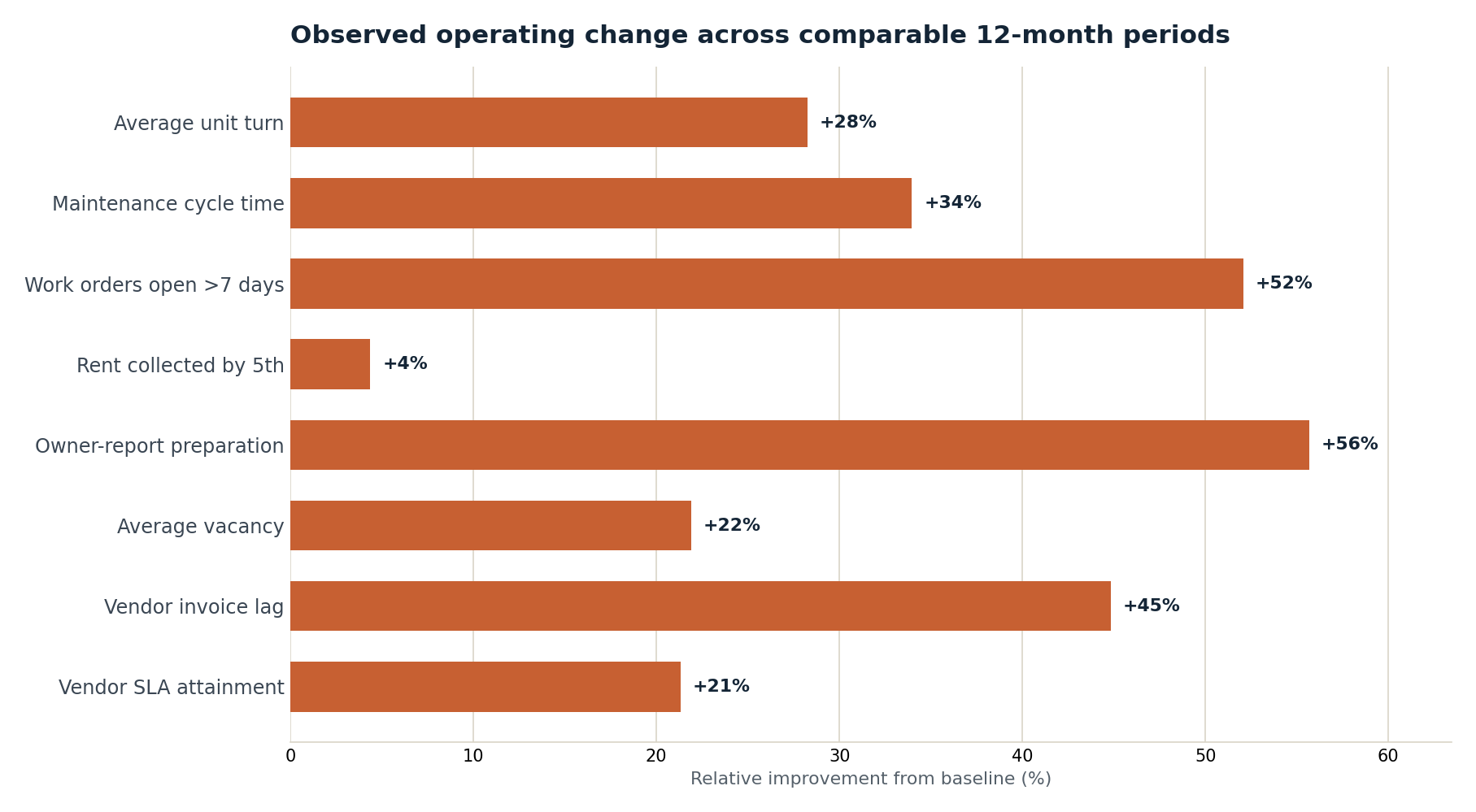
Across the 12-month post-redesign period, the redesigned operating system moved unit-turn speed, work-order aging, collections, owner-reporting effort, and vendor performance — leadership no longer had to review 780 units to know which twenty needed intervention.
| Measure | Baseline | Post-redesign |
|---|---|---|
| Average unit turn | 18.4 days | 13.2 days |
| Maintenance cycle time | 5.3 days | 3.5 days |
| Work orders open >7 days | 21.7% | 10.4% |
| Rent collected by 5th | 87.2% | 91.0% |
| Owner-report preparation | 31.8 hrs/mo | 14.1 hrs/mo |
| Average vacancy | 24.2 days | 18.9 days |
| Vendor invoice lag | 8.7 days | 4.8 days |
| Vendor SLA attainment | 70.4% | 85.4% |
Figures reflect a modeled before/after operating dataset for privacy and demonstration. They describe results within this case, not guaranteed outcomes or industry benchmarks.
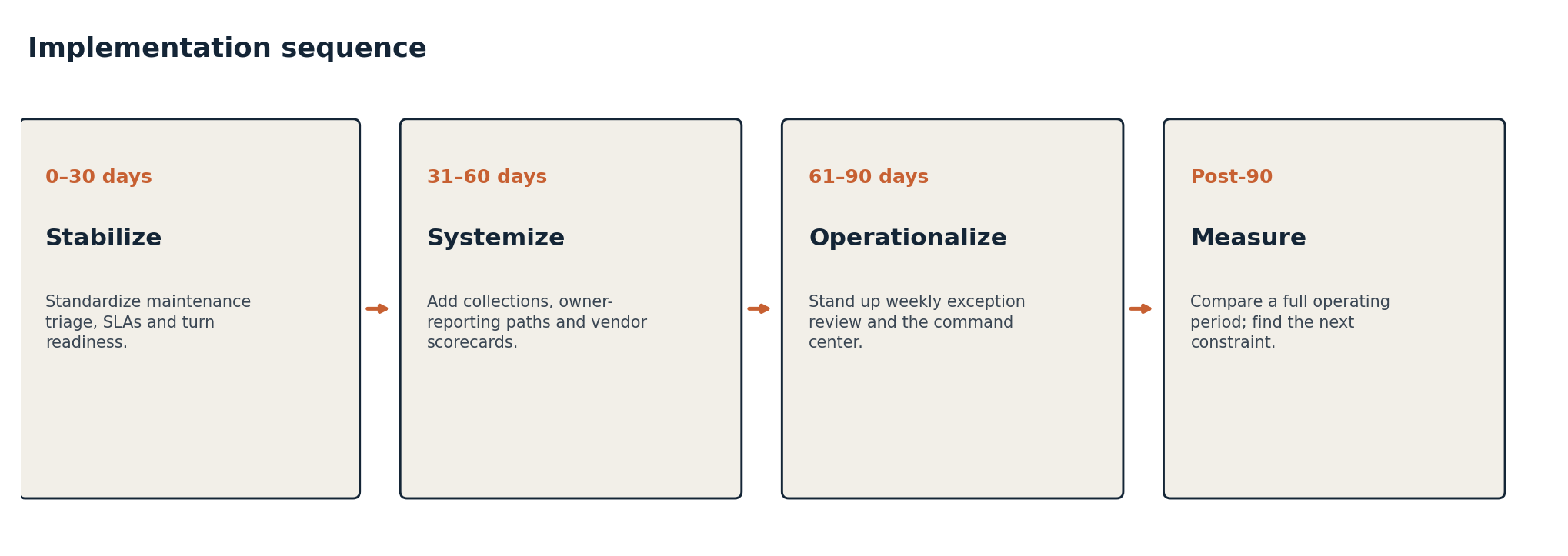
Book a free Workflow Assessment and map how portfolio status is produced — before adding another tool, person, or layer of management.
Book a Free Workflow Assessment →