

Introduction
Small business automation tasks are no longer limited to accounting software or basic scheduling tools. In 2026, AI makes it possible to reduce manual work across nearly every part of a small business — without replacing people or rebuilding systems.
The goal is not automation for automation’s sake.
The goal is removing repetitive, low-value work that quietly drains time every week.
This guide breaks down the top 10 small business automation tasks that are best suited for AI today, along with guidance on how to approach them realistically.
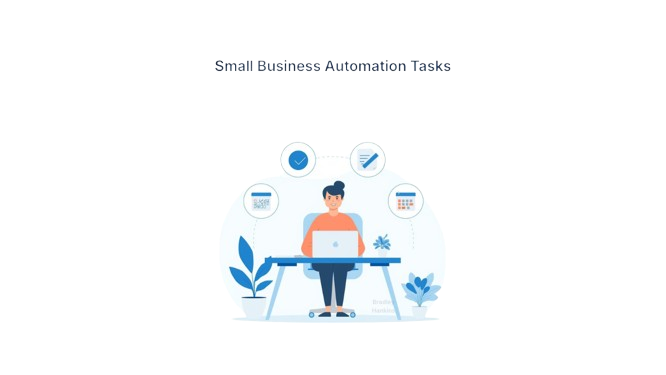
Table of Contents
Why Small Business Automation Matters Now
Most small businesses don’t fail because of strategy.
They struggle because operational friction compounds over time.
Manual emails turn into delayed responses.
Unlogged notes become missed follow-ups.
Inconsistent processes lead to burnout.
AI automation works best when applied narrowly and intentionally, starting with the most repetitive tasks.
1. Email Drafting and Follow-Ups
Email remains one of the biggest time sinks for small business owners.
AI can assist with:
- Drafting follow-ups
- Formatting responses
- Maintaining tone consistency
- Reducing response time
This is not about auto-sending emails. It is about eliminating blank-page writing.
2. Appointment Scheduling and Reminders
Scheduling involves more than booking a time. It includes confirmations, reschedules, reminders, and no-show prevention.
AI-supported scheduling workflows:
- Reduce back-and-forth communication
- Improve attendance rates
- Free staff from manual coordination
3. Estimates, Proposals, and Reports
Generating estimates and reports is necessary — but rarely strategic.
AI can:
- Draft first versions from templates
- Insert customer-specific details
- Standardize formatting
This speeds up delivery without sacrificing review or accuracy.
4. CRM Notes and Client Summaries
Many small businesses underutilize CRMs because logging notes feels tedious.
AI can:
- Summarize calls
- Structure notes
- Tag key information
- Reduce data entry fatigue
This improves follow-ups and visibility without adding workload.
5. Meeting Notes and Action Items
AI excels at converting conversations into usable output.
Automated meeting summaries help:
- Capture decisions
- Assign tasks
- Prevent missed follow-ups
This is especially valuable for small teams juggling multiple responsibilities.
6. Recurring Administrative Tasks
Examples include:
- Weekly reports
- Status updates
- Internal checklists
- Reminders
AI automation reduces cognitive load by handling repeatable admin work in the background.
7. Customer Support Draft Responses
AI should assist — not replace — customer service.
Used correctly, it:
- Drafts responses to common questions
- Maintains tone consistency
- Speeds up response time
Human review remains the final step.
8. Content Summarization and Repurposing
AI can turn:
- Long emails into summaries
- Notes into documentation
- Conversations into internal guides
This keeps knowledge from getting lost.
9. Task Prioritization and Workflow Planning
AI can help identify:
- Bottlenecks
- Repeated delays
- Overloaded workflows
This is less about prediction and more about clarity.
10. Internal Knowledge Lookup
Instead of searching folders or old emails, AI can surface:
- SOPs
- Prior decisions
- Process documentation
This saves time and reduces dependency on individuals.
Common Mistakes to Avoid with Small Business Automation Tasks
- Automating too much at once
- Removing human review too early
- Choosing tools before defining workflows
Start small. Improve one task. Expand gradually.
Why Automating Small Business Tasks First Creates Momentum
Small businesses don’t need to automate everything at once. The biggest wins come from identifying repetitive tasks that drain time but don’t require creativity or judgment.
When automation removes just a few friction points, business owners often notice:
- Faster response times
- More consistent follow-through
- Reduced mental load during busy weeks
This momentum makes it easier to expand automation later without disruption.
Conclusion
Small business automation tasks are not about scaling aggressively or replacing people.
They are about:
- Reducing friction
- Improving consistency
- Creating breathing room
Businesses that approach AI practically gain an advantage without disruption.